
The Ethics of Lingering On: Work, Leisure, and Identity in Perfect Days – Sude Kılıç
Days Like Any Other: Rhythm of the Work and Silent Meaning
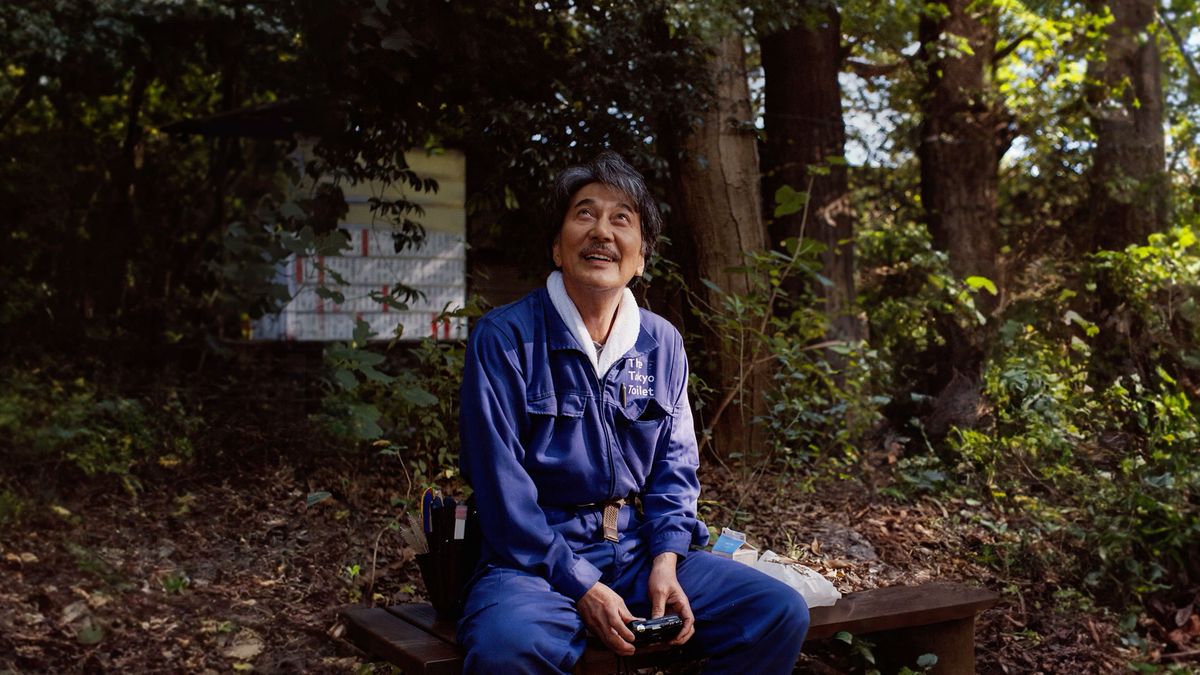
Perfect Days, unfolds the story of Hirayama, a man who lives a quiet, slow, solitary life where each day seems to mirror the last. He wakes to the whisper of leaves and the distant sound of a street sweeper outside, every morning. As he folds his bedding, a book lies at his bedside – a silent clue that he read before falling asleep. The film allows us to get to know him slowly – as if we have taken the shape of the shadow of his life. He gets ready for the day, waters his plants – all in serenity. The moment we see his uniform, we realize, he cleans the public toilets across Tokyo. It feels like this detail brings us one step closer to knowing him – as if, in that moment, the work a person does, not how they do it, can reflect a part of who they are. Maybe, we might expect him to be unhappy; after all, soon he will be scrubbing toilets – a tiring job that pays little. Nonetheless, the second he steps outside, he greets the day – he looks up at the sky, and we look at him – we catch a glimpse of something pure, the radiance in his eyes. The feeling of intrigue wraps us around, he seems almost way too joyful for someone on his way to clean toilets – can he be at this peace, we might think, oddly. Each morning, we live our own ordinary lives, shaped by routine – sometimes joy finds us, sometimes it does not. We yearn for happiness, we live in pursuit of it, searching for it in the tiniest things – even if we cannot always find it. We love life most, when it is not too hard to bear, when it flows with ease, yet, something deeper begins – a love for living, even when it feels like a burden.
Hirayama seems to have found this quiet joy in a task many would call a burden. Each day, he cleans the same toilets, with the same tender care – even as his coworker reminds him that they will only be soiled again, and even in his heart, Hirayama knows this truth all too well. Ciulla (2000) writes, “Work works for us. It offers instant discipline, identity, and worth. It secures our time and imposes a rhythm on our lives… and perhaps most important, work tells us what to do every day” (p. 7). In the light of this, waking up each day already knowing how it will unfold and in a sense, finding the day already laid out before us, does not so much render it dull or devoid of value or even if it does, it still grants us a form of discipline, one that leaves little room for uncertainty, and thereby guides us along a path that is, from the beginning, already secure.
Hirayama sees a rhythm in the days that seem dull, monotonous, hauntingly the same – like a song whose melody may not move everyone, but whose quiet beat speaks to him. A rhythm to follow, a pattern that holds him close to life, to what is real. Perhaps he sees the value that rises from the rehearsed, predictable hardship of his work – like a person surfing with the familiar waves, he unearths himself in the known currents – and from within them, creates something of quiet beauty.
This ever-repeating rhythm of work, rather than reducing life to monotony, reveals a personal cadence through which one actively creates meaning from their work and bestows meaning upon it. The meaning of work is never separate from the person who does it, nor from the meaning that person creates from within the work itself. The meaning of work is deeply bound to how it is used – how people form it with their touch, gather meaning from their thoughts, and keep it alive with their hearts. To separate the concept of work from the worker, and from the meanings they breathe into their tasks, feels contrived – even hollow. Essential point perhaps is recognizing work not merely as an activity, but as inseparable values and ideas attached to the essence of work. The power to breathe meaning into work comes from the person – from their own motivation, their own stirring toward life. External forces become a dying spark, no matter how sorely they seem to be blazing at first glance. (Ciulla, 2000, pp. 23-26). All of this flows into Hirayama – he does not merely stand outside of his work, looking at it – he is within it. His work is no longer just an activity for him, even if the task is cleaning toilets all day, it has become one with him. He fulfills his work with all his values, insights, and his very being intertwined. Though the work he does is hard and exhausting, the meaning attached to it manages to rise above its sheer, unadorned difficulty – for Hirayama, from within a noise-filled struggle, a silent meaning begins to emerge. Hirayama is not merely filling time with an activity as he works – he fully possesses the time he spends, and time takes form in his hands. Rather than slipping away, time reshapes from an external task into an inner accompaniment. Yet, despite everything, the work is carried out with tender care and in ways that benefit others, and though it is imbued with profound meaning – this meaning is not always recognized by the world around it. It unveils the pure injustice in how labor is valued.
Work in the Shadows: On Justice and the Need to Be Seen
The delicate meaning Hirayama renders into his work is not always met with the same grace. The film captures this injustice, the neglect of meaningful labor – in a way that is quiet, yet sharply felt. One of the most quietly devastating scenes in the film, to me, is when Hirayama, doing his work with quiet care, encounters a lost child inside one of the toilets in the park. The little boy is crying – he has lost his mother. Without hesitation, Hirayama holds his hand and helps him by searching for his mother. Before long, the mother appears, shouting the child’s name and rushing toward him. The woman abruptly takes the boy away from Hirayama, without a word of thanks – without even properly looking at Hirayama. The woman pulls out a couple of wet wipes and scrubs the child’s hand – the one Hirayama held. Hirayama watches, sees it all – with an almost unnamable expression on his face, maybe melancholy. In the eyes of some, apparently, cleaning toilets is enough to make a person dirty and enough to render a person unworthy of being touched. Yet, as they walk away, the little boy turns back and waves at Hirayama. In that fleeting moment, something touches Hirayama deeply, softens his sorrow – perhaps it is the feeling of knowing what he did was right, even when no one thanks him for it.
Hirayama’s invisibility in the eyes of a complete stranger reflects how society measures the worth of certain kinds of labor. However, when this disregard comes not from a stranger, but from one’s own family, it cuts deeper – uncovers a sorrow of an entirely different kind. In one of the other scenes of the film, Hirayama has a brief and bitter encounter with his sister, whom he has not seen in a long time. She looks at him and asks, almost in denial, almost as if he had done something terribly wrong: “Are you really cleaning toilets?” The question wounds him deeply – his eyes well up. After she leaves, he breaks down, and the sorrow catches him quickly. Nonetheless, the sorrow he feels, I believe, does not come from any shame in his work. It is the look in his sister’s eyes – almost a pity, the unspoken judgement. Hirayama’s heartache comes from being unseen, of acknowledging that even someone who should be the closest to him, cannot recognize the stillness he has shaped into a form of dignity. Not a stranger, like the woman from the park – but his own sister. That is the weight he carries – heavy enough to sometimes crush him.
These scenes reveal something that extends beyond Hirayama’s quiet sorrow; they cast light on a broader frame – society’s stance upon labor, and upon the one who carries it out. It evokes the idea that everyone wants public toilets to be clean – in schools, in libraries, in parks, in workplaces… Dreaming of spotless public restrooms. Yet, this common and shared desire for cleanness, for some, is inherently connected with looking down on the very hands that clean them. As if the result, a clean toilet, could exist altogether separate from the person who made it so. It is almost as though toilets clean themselves. The two scenes I have touched upon reveal something deeply strange, almost absurd, about a nearly universal human need; some treat its provider with disdain, as if the degradation is the reward itself.
In the Clean and Dirty Work chapter of her book, Ciulla touches on ideas that cast light upon these very scenes. In Ancient Greece, working for others, particularly through physical labor, was not seen as respectable. For Aristotle, artists and laborers should not even be considered as citizens, their only role was to serve society, a duty bound by necessity, not by freedom (Ciulla, 2000, p. 38). Though over two millennia have passed since such approaches, one cannot help but feel their echoes still linger today. Just as Hirayama is unable to earn the respect of his own sister, the melody of an old song still remains in the ears of many. Ciulla (2000) then emphasizes, “Even though Aristotle was writing in the golden age of Greek sculpture, he did not think that sculptors should be citizens, because sculpting involves strenuous physical labor” (p. 39). This stirs a thought, even though Ancient Greek sculptures were crafted with delicate care, masterpieces admired in their time, and today, Aristotle, who was a person of that era, who experienced their splendor firsthand, believed that those who created them should not hold the same status or worth as he did. Since each sculpture is born out of physical labor – of sweat and strain. Personally, this exposes a distorted way of thinking – not only a lack of appreciation for the artist, further, pure blindness, not to what is created, but to how it is created.
Hirayama, perhaps the mirror of these ancient positions in modern times, receives no affirmation, no regard for the dedicated effort he puts into his work, yet this does not estrange him from himself. He knows what kind of person he is – does not lose himself in others, nor in the judgments. He not only finds himself in his work – but he also builds himself through it, in the quiet pride and happiness of doing it well. Perhaps for Hirayama, the joy lies in simply following the path he knows to be the right one – by remaining faithful to his work, he remains faithful to himself as well.
A Quiet Becoming: Between Work and Leisure
The pure meaning Hirayama shapes from within, the rhythmic sense that gives his life its depth – does not arise from work alone. In each silent moment in which we witness him quietly becoming himself, we are reminded that what deeply makes us who we are is not only created through the labor we are required to perform, but also by how we choose to spend the time we call our own. When Hirayama returns from work, or on his quiet days, he always reads. On his way to and from his work, on the days he does not work, he listens to music on his cassettes. He rides his bicycle through the city, watches the trees, and takes photographs of them. He gets the meals he loves, in the restaurants he loves, surrounded by familiar faces and serene comfort. He does not do these things to pass the time, but to dwell in it – to make it his own. These are the moments when no one expects anything from him, when time belongs wholly to him. Through these moments, through how he chooses to spend his hours of stillness, Hirayama is defined. In the still rhythm of his labor of love, he shapes the self we come to know as his own.
Just as we come to know Hirayama through the way he works, what he does in his spare time offers a valuable insight into his character, as well. Aristotle believed that leisure was essential to living a fulfilled life. However, for him, leisure was more than merely free time or idle hours. It was the moments when one ought to engage in meaningful pursuits – not a time to just rest aimlessly, but to nourish the inner sense of self. Leisure, from Aristotle’s perspective, is for humans to practice the best part of their very being: the capacity to think, to learn, to create – the realm in which the absolute wisdom is born, and the identity is cultivated out of it (Ciulla, 2000, pp. 6 & 192). Aristotle’s idea might feel elusive to someone who has worked through the week at a relentless pace and desires to spend the weekend doing absolutely nothing – and I would truly and completely understand that. Sometimes, what one needs the most is to rest without thinking, without learning, and without creating, and this perhaps brings a deeper and more lasting inspiration in the later stages. I suppose that this tension might deserve an exploration elsewhere. Going back to Hirayama, I believe it is clear that the activities that fill this free time align closely with Aristotle’s concept of leisure. Reading almost every night before bed, spending the weekends with the company of books, and looking through the bookstore to find new ones. Picking up his photographs, setting apart the negatives from the ones he would like to keep – a way of preserving what he has seen, what he considers meaningful, holding onto those moments he captured and making them eternal. The tender care he gives to his plants – a devotion, an attention of his which shows itself for every living thing. Strikingly, while Aristotle might not have held Hirayama in high regard for the nature of his labor, he would have admired him for the way Hirayama chooses to spend his leisure.
In one scene of the film, when Hirayama’s coworker suddenly quits, Hirayama is left to clean twice as many toilets as he usually does in a single day. The weight of it exhausts him; further, it steals from him the time and energy he usually devotes to the small rituals he loves – visiting the public bath, a quiet meal at his favorite restaurant. That night, he falls asleep the moment he returns home – without even opening his book. This moment lightly reveals the deep thread between the time he gives to his work and the time he gives to himself. When the hours meant for labor begin to spill into the hours meant for not working, when we find ourselves working more and more, what we begin to lose is not just time – but the strength, the will, to spend it on ourselves. All at once, the way we do our work and the meaning we breathe into it take form within the bounds of the time we are able to claim for ourselves. The way we carry out what we must do, our jobs, studies, responsibilities, is deeply shaped by what we do when we are not doing them. Knowing, at the end of the day, one will return to a time that is wholly their own, not only brings joy, but also creates a powerful motivation. It becomes the ground upon which wholehearted work can stand. For Hirayama, the freedom to step away from his job and to step into his books, his music, his softly unfolding evenings, is what allows him to return to his work the next day with the same calm devotion. Simultaneously, this gives him space to savor his leisure more thoroughly – the knowledge that he has worked well, with care.
In the Work that Calls chapter of her book, Ciulla reflects on how tasks once seen only as burdens, almost as curses in Ancient Greece, took on the form of “calling” within Protestant work ethics. Protestants believed that regardless of one’s job, it was through that very work and more crucially, through one’s attitude toward it, that one could find both oneself and salvation. Work became a means through which a person could discover, shape, and express their character. The notion of calling was tied to the belief that all forms of labor were commanded by God, and every individual, no matter how difficult or poorly rewarded their labor might be, was capable of creating meaning out of their work. Even though the concept of calling was once firmly rooted in divinity and devotion, it gradually became secularized. Yet, even stripped of its religious frame, it retained its spiritual value – the spiritual and emotional layers of finding meaning in what one does. Eventually, calling evolves into vocation; we no longer seek God’s pre-given path to follow, but we ourselves discover and carve the passage with our own hands (Ciulla, 2000, pp. 51-53). The same holds for Hirayama. Though we have no signs that he clings to any divine force, it almost feels as if he does – so deeply he finds himself in his work, with a quiet devotion that borders on the sacred. Cleaning filthy toilets all day, earning little, and living a modest, hushed life – these are not his curse, but his salvation – his vocation. With an inclination that seems to rise from the depths of his being, he weaves meaning into his labor. For Hirayama, vocation is not limited to the meaning he infuses into his work, because of the deep connection that binds work and leisure, he also makes himself in the time that is wholly his own. Hirayama carries his spark within. What stokes the flame is both his work, and all he does when he is free not to work. The tasks he must do, and the moments he freely chooses to shape, are what make Hirayama who he is in the film – and what will keep shaping him, endlessly and still. The silent, yet unwavering answer to a life well lived.
Behind Vocation: Time, Leisure, and Money
Behind this whole creation of meaning, we begin to sense something else – something that keeps us tethered to the world, like a chain around the ankle, anchoring us to the gravity of reality: the need to earn a living. Finding a way to feel joy, to shape meaning, to keep our leisure time alive – and to let time pass as if it truly belongs to us – we must earn money. In our present reality, the necessity of making a living has become the condition of being human, woven into everything we might hope to create for ourselves, the meaning we find in work, and the freedom we carve out in our hours of rest. This, too, holds for Hirayama. The money he makes becomes the instrument not only for survival, but also a means of meaning, the purpose that comes from knowing he will spend what he earns on books, cassettes, film rolls for his analog camera… on things that bring him peace. This sense of peace, even though through the exchange of time for money while working, carries within, from its other side, a different experience of time. A time which is not measured by hours or wages, but flows like the streams of a river – endless, infinite. There is a sense of freedom in knowing that when the work is done, one can return home – return to the things one can do without the pressure of hours. Remembering that work occupies only a finite stretch of time brings a powerful motivation, the promise of life beyond the clock (Ciulla, 2000, pp. 175-182).
A life beyond the clock. As for Hirayama, it is not merely about shaping long hours freely; it is about filling the time he holds and molds without thinking of the outcome, without breaking it into segments, without the pressure to complete anything. The moments when he truly feels alive – the brief moments he spends watching trees sway in the wind, the meals shared with the gentle conversations of strangers, the few pages of a book read before sleep. It is not about how much time he spends in these moments that matters, but the sincerity they carry, the meaning they stir within him. Beyond the hours followed by a clock, beyond how many toilets he cleans or how much money he earns, there exists another kind of time that cannot be counted, only lived. Moments that cannot be measured by the clock, but truly belong to him. Perhaps, this is the one reason beneath Hirayama’s way of working – not to escape time, but to have the freedom to shape it as he wishes. Every coin he earns is, in a way, a promise of the things he loves to do.
Tic-Tac-Toe: Work as Hope and Quiet Act of Reaching Others
For Hirayama, the relation between work and leisure, after tracing the different experiences of time, might at first glance appear as a simple exchange – a duty performed and a wage earned. But for Hirayama, I believe it is something far deeper than simply enduring what he does not enjoy, his job, to reach what he does enjoy, the time for himself. Even though I believe the things he does in his spare time are a great source of motivation for him, Hirayama is nowhere near giving the impression of merely “putting up with” his work for his freedom. Hirayama is someone who has transcended the view of work as a burdensome obligation. His work is no longer just a sacrifice of time for money, but the very act of doing it gives rise to something else – something meaningful. His job has some value in it – layered meanings that seem to be created from the act of doing it. Hirayama carries a hopeful soul within his body – every morning, as he heads out into the city to begin again.
There is a kind of hope – a hope that lingers subtly, that is never rooted in a particular thing, a person, or the promise of some change. It is a quiet hope, born from doing one’s work with care, from honoring it, from giving it value even when no one is watching. Hope, at times, is simply the feeling that arrives in the most unexpected moments – that this gentle devotion has, somehow, reached someone else with a small act, with a moment of care.
In one scene, Hirayama finds a half-finished game of tic-tac-toe in one of the toilets he is cleaning. He is almost about to throw the piece of paper away, but then he hesitates and stops. He draws the next move himself and places it right back where he found it. This exact scene has made me think of Ciulla’s (2000) words, “These meaningful acts are distinctive because people do them with a good will and not for the sake of a paycheck. They are inherently rewarding and often occur unexpectedly. Such moments fill valuable lives. A life abundant with small acts of kindness is not necessarily a happy life, but it does have meaning because it leaves behind something that mattered to others. And is apt to be happier than a life that lacks such moments” (p. 226). A forgotten piece of paper becomes a connection, a moment of shared purpose with an unseen stranger. Not a mere tool to help him endure his job, but something that fills the day with wonder, with meaning, with hope. A spark of joy that he discovers within and through his work, not beyond it. Ciulla draws on William Morris’s vision of “worthwhile work,” quoting his view that work can be either “a lightening to life” or a “burden to life.” The difference, Morris argues, lies in the presence or absence of hope. According to Morris, it is hope that makes people want to work and makes work worth doing (Cuilla, 2000, p. 66).
This resonates with Hirayama’s perspective of his work, worthwhile work through which he finds the very hope that breathes life into his days. Each morning, Hirayama moves through his day with a quiet spark, wondering if the tic-tac-toe game has been continued, carrying in his heart that gentle, unspoken glimmer. It is this pure hope that gives his work a quiet glow, transforming even the smallest task into something illuminated by meaning. Perhaps, this is the very thing that makes Hirayama’s work not merely endurable, but graceful – not only because others see its worth, but because he himself, completely, does.
Lingering On: Perfect Days
Hirayama, in one of the scenes, murmurs slowly, “Next time is next time, now is now” (Wenders, 2023). I genuinely believe that this one sentence of his carries far more meaning than it first reveals, words that slowly unpack their own meaning, as the film unfolds. One thing I can say is that to truly see the present as the present, to perceive time not in sections, but as a whole, is a way of grasping that the time spent on the work holds a dimension beyond earning money. The very essence of being in the moment, a commitment to the now, a rhythm that binds a person not to consequences, but the slowly unfolding process itself. Simultaneously, it allows one to gain the fullest joy from the moments of leisure, from the pure happiness felt while doing the things we love. It absolutely transcends simply “living in the moment” – revealing the stranger relationship between people’s work, their leisure, and their identity. Strange, because even though we believe we can reflect on these things separately, and at the same time see how deeply they intertwine, they remain just as complex, messy, fluid – and resist being held. Just like people, and the chaos we bring with us.
When all is said and done, I suppose, as Camus once said, one must imagine Sisyphus happy. Perhaps we also must imagine Hirayama the same way – happy, and living his life to the fullest as he “lingers on” with the small rituals of his days, his work, his little pleasures. As someone who has given value to the weight of the boulder he carries. Someone who acknowledges that some days, pushing it forward feels heavier than others – but still, perfect days.
References
- Ciulla, J. B. (2000). The working life: The promise and betrayal of modern work. Three Rivers Press.
- Wenders, W. (Director). (2023). Perfect Days [Film]. Master Mind Ltd.